
School with a Trinity of Names
 |
 |
|
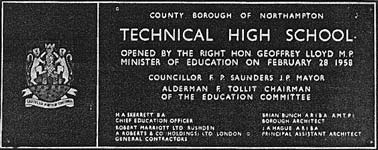
The Technical High School, formed in 1946 finally became the Trinity Grammar School, not long before it became a comprehensive, but using the "compromise" name of Trinity High School in-between. |
|
If grammar schools had a section in the Guinness Book of Records, Northampton might well figure in it, two of its former schools in this category being notable for long (433 years) and short (five years) periods of existence.
Until three years ago the town had three grammar schools, one for boys (Northampton Grammar School, Billing Road), one for girls (Northampton School for Girls, St. George's Avenue) and one mixed (Trinity Grammar-school, Trinity Avenue).
Founded in 1541, with Lawrence Washington, of Sulgrave Manor, as one of its trustees, the boys' establishment survived as a grammar school until 1974, when it was submerged, along with the other two, in the tidal wave of comprehension (or is it comprehensiveness?). Thus it lasted well over four centuries. Whether the death by drowning of such venerable schools amounts to educational murder (or "sacrilege" as a retiring grammar school teacher wrote in the "Daily Telegraph". the other day) is a point I do not propose to pursue here.
The mixed Trinity Grammar School had, on the other hand, a life of a mere five years under that name. Taken together the two contrasting cases surely merit a mention in any record of scholastic longevity.
But "Trinity Grammar School" is only one of three names which the school had in the first 28 years of its life, prior to 1974 when it became simply Trinity School, an upper school in the comprehensive system. The other two names, making up the trinity, were the Technical High School and Trinity High School. And thereby hang tales of confusion of identity, angry debate and allegations of snobbery.
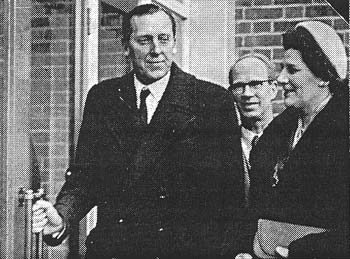
The "man himself" Minister of Education opened the school.
The Minister, Geoffrey Lloyd unlocked the door in March 1958 watched by Alderman F Tollitt (chairman of Northampton Education Committee) and the Mayoress (Mrs F. P. Saunders)
The term now commencing at Trinity school marks the 20th anniversary of full occupation of the present premises, a period inaugurated by no less a person than the then minister of Education, Mr. Geoffrey Lloyd. But the school had its roots half-a-mile away in a Junior Technical School set up in St. George's Avenue, opposite the Racecourse, as part of Northampton College of Technology. In those days the present site of Trinity School was occupied by allotments.
The first newspaper mention of the Junior Technical School which I have come across is of the staff and pupils joining in a service on the playground of the College of Technology on Thursday, September 4, 1942, marking Britain's entry into the fourth year of war. That day the wheels of industry and of educational and other establishments in Britain stopped for 15 minutes. At the Northampton college a B.B.C. service marking the anniversary was broadcast, pupils of the evacuated Paddington School joining in the parade.
Two years later, in 1944 came the Butler Act for the post-war reorganisation of education, adopting the entirely new principle that secondary education should be available to all up to the limit of their ability and capacity. It was all part of the brave new world which was to follow the War.
The sub-committees set up in Northampton to plan for local changes decided to create a Technical High School as part of the new secondary system thus "recognising the need for the fullest possible application of science to industry in the future."
Thus, at the war's end, the Junior Technical School, which had taken pupils at 13-plus, became the Technical High School, with an intake at 11-plus (as regards age intake the wheel seems today to have turned full circle). The scheme was for boys and girls to be in the proportion of three to one - a three-form entry of boys and one of girls, with a total roll of 630. Appointed as the first headmaster was Mr. B. S. Howard who was to remain in charge until the summer of 1974.
The school had two problems, of premises and identity. Though it now had a separate status it continued to share the buildings of the College of Technology and this led to many difficulties despite excellent relationships between the two. As Mr. Howard recalled at the Speech Day of 1958, the first in the new premises: "During the past years the school has gone through every possible contortion and some impossible ones too. From force of circumstances it has operated at various times without most of the things which are usually regarded as necessities in schools and for one year it operated in two different halves indifferent buildings!" This reference was to the time when half of the school had moved into the completed part of the new premises, the other half remaining in the College.
I had hoped to hear some further elaboration on the problems of shared and divided premises from Mr. Howard, who retired three years ago but he politely declined to reminisce, preferring to "stay retired."
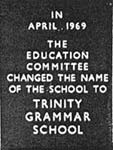
I would also have liked to ask him about the school's even greater problem of identity during most of his 28 years as headmaster. For it was only after a battle against authority and against what was sometimes alleged to be entrenched snobbery that the school was finally allowed in 1969, to call itself a "grammar." It was a belated victory for by that time the name then adopted was already obsolescent, doomed under the interim scheme for educational reorganisation which preceded the comprehensive system.
One senses something of a heart-cry in the remarks of the headmaster at the 1960 Speech Day. Why should secondary schools be labelled with names like modern, technical and grammar, asked Mr. Howard. "It might have been better if we had been content to think of them all as just good schools as indeed most of them are." Even then, 14 years after the school's formation, he felt obliged to outline just what it did stand for. "There has been some misunderstanding about what technical high schools do. The word technical in our name means that we are additionally equipped to give girls who wish to have it tuition in commercial subjects and boys who have no aptitude for a second language additional craftwork." He advised parents: "You need not fear, therefore, that if your boy or girl comes to us he or she will be thrust into an excessive amount of craftwork or commercial training. These things are there for students who need them and wish to have them. Otherwise the programme is good straight forward general education." That year, incidentally, saw the first woman guest at the Speech Day - Miss E. L. Madge, principal of North Riding Training College.
Besides the matter of its significance, the name, Technical High School, had an inbuilt confusion factor. Many people shortened it to "The Tech.". But this was also the familiar title of the College of Technology (which is today the Nene College, Avenue Campus - confusing is it not?) and, confusion was inevitable, especially during the sharing of buildings. Even after the T.H.S. had moved out into Trinity Avenue uncertainty continued and the mail would sometimes arrive at the wrong school.
Even teachers were misled by the name, judging by the claim of Councillor Kenneth Pearson when pleading for a change. Many first-rate teachers did not apply for posts there, he told Northampton Town Council, because they were put off by the word technical.
Just what was the role of the "Technical High School"? In making a decision to build a new home for the school the Education Committee said that it was influenced by the Percy Report which placed emphasis on the need for the fullest possible application of science in industry, by the necessity of counteracting the defection of many of the best pupils into non-industrial occupations, and because of the variety of industries growing up in Northampton. Another reason was that the College of Technology was bursting at the seams and needed the whole of its premises: for this - reason part of the £227,000 needed to build the new school came from a Further Education appropriation.
The Minister of Education himself elaborated on the school's role when he officially opened it on February 28, 1958. Mr. Geoffrey Lloyd asked. "Have we been adapting ourselves fast enough to meet the changing and more scientific character of the world and particularly of industry? It is most pleasing this afternoon to be in this magnificent new school, which is a most practical form of answer to this criticism. I think it is true to say that this school is really a modern form of grammar school. In the 19th century there were strong arts and classical components in grammar school training but scientific studies are also very good for intellectual discipline."
The Minister was perhaps a little premature when he praised Northampton's approach, with "no rush for any particular form or nostrum or educational fad."
The school was among 1,136 new secondary schools built since the war. Along with 2,644 new primary establishments over two million new school places had been provided. The names of the then Borough Education Committee (education was still in borough control then, of course) will bring back memories to many readers. It included such varied personalities, with such diverse views, as Dr. E. E. (Gus) Field, Mr. J. L. (Len) Piggott, Councillor Bernard Tippleston and Alderman Len Smith. All these have now passed on, as has also the then Borough Education Officer, Mr. H. A. Skerrett.
If the T. H. S. was indeed a "modern form of grammar school" why not call it as such? But to do so might upset some of the Old Boys of Northampton Grammar School, with its 400 years of tradition. To call the upstart academy in Trinity Avenue by the same name would be an insult to the Billing Road establishment. And certain Old Boys on Northampton Town Council and its education committee were determined that this should not occur. A notable exception to this was Sidney Clayson, one of the councillors who was not only an old boy of the Grammar School but also a governor and who spoke in a Town Council debate on the school's name in January, 1961, favouring the adoption of "Trinity Grammar School" and insisting that the traditions of the older school would not be affected.
The question of changing the name came to a head in 1960. When the Governors first discussed the matter they decided, surprisingly, on no change, but had second thoughts after some discussion on the subject in the education committee, and recommended that the name be altered to Trinity Grammar School. Councillor F. Tollitt, chairman of the Governors, said that the original name of "Technical High School" was a misnomer and did not help to eliminate confusion.
But they were overruled by the Town Council who in December, 1960, substituted "Trinity High School" a name which the compromising Councillor T. S. Kinch had observed was "pleasant sounding" and would prevent a "head-on clash with the town's grammarians". Mind you he thought it was an insult to override the governors' choice, and added that of all the misnomers of education the word "Governor" was the most misleading as they had powers to do very little except see that the right type of cane was employed.
One of the opponents of the use of the grammar title was the man who had laid the Trinity Avenue school's foundation stone in March, 1954, Alderman Arthur Chown, who, as education committee chairman, was quite blunt in his opinion - "it is rather ridiculous to say that it is a grammar school".
The reader might by now be asking himself questions about roses smelling as sweet and what's in a name anyway but the deep significance of the matter was amply demonstrated when two fathers so strongly objected to sending their sons to the school that they kept them away altogether and became involved in a head-on and widely reported collision with the authorities. In 1962 a father who had opted for his son to be sent to Billing Road and objected to him going instead to Trinity Avenue took strike action and kept the boy at home for months. Confident, no doubt, that their decision would be upheld the local authority appealed to the Minister, who, however ruled otherwise and to Northampton Grammar School the lad went. The following year another father tried the same form of opposition but this time the Minister ruled against the parental choice.
The incidents prompted the head boy of Trinity High School, Peter York of King Edward Road, to write to the Press criticising this waste of the boys' school time and infighting over "differences between two practically equal schools." Trinity, he declared, was a school which "any boy would be proud to attend."
Ex-pupils joined in the debate. From Leeds University, Courtney Finn, secretary of the university's Technical High School Old Students' Association, claimed that the school, which "is of grammar school status although it has no feudal roots", had a range of subjects which was the best in the town.
But equality means different things to different people. April, 1969, the month when Trinity finally got the right to call itself a "grammar" also saw the rejection of a plea that it should get an intake of pupils of equal ability to Northampton Grammar School. The matter was raised by Alderman F. Tollit, chairman of the governors, who said that renaming the school brought it parity in name only. "I want to see parity in practice" he said. "The Grammar School has been taking the cream of the pupils and leaving the rest for Trinity".
But discussion on these lines was becoming somewhat academic. The Grammar system was itself already doomed. Replying to Alderman Tollit, Councillor David A. Walmsley, chairman of the education committee, pointed out that this was to be the last year of selection at 11-plus if the interim scheme for secondary reorganisation was to be adopted. Which it was.
When the Mercury and Herald ran a feature on Trinity that year its headline was "The youngest Grammar School." One small point it mentioned was that stiletto heels were banned for functions in the school hall - a flashback to the pre-clumpy days.
But if there were those who had tried to depress Trinity below the 400-year-old grammar school it should be remembered that further down the ladder in those days were the secondary modems and in July, 1961, Mr. Howard had gone along to one of these, at Duston, to present sports prizes. He said he was pleased to see that secondary modems were now taking the G.C.E., a move which he suggested would "take a lot of the sting out of the 11-plus and end much of the criticism of it." There was also the system of transferring pupils who were successful in the G.C.E. to the Sixth Form at Trinity and at the time he had 10 ex-secondary-moderns in the Sixth Form. A few years later he was able to report considerable successes by those transferred, a number of whom went on to teacher training and to university.
From time to time the school had its disciplinary problems some of which reached the local newspaper, as in November, 1960, when a warning appeared on the notice board that caning would be imposed for spooning, sky-larking or fighting' on the pavement. When addressing teachers pupils were to stand straight and say Sir. In March, 1970, the head sent 14 boys and girls home just before term end "to cool off."
There were also a few cases of damage to the premises as in December, 1967, when caretaker Eric Gosling, of 140 Balfour Road, found that vandals had flooded a school workshop, and in November, 1970, when a blaze wrecked the school's wooden sports pavilion, built five years earlier.
The school also suffered from the universal syndrome of pupils over-indulging in TV and the head coined a phrase in his 1962 Speech day report when he said that an Englishman's home was now not only his castle but also his cinema.
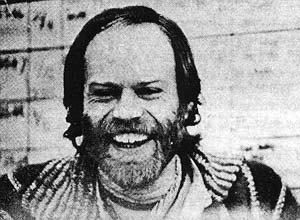
Bob Harris the radio and TV DJ is a former pupil, who started in 1957 and left in 1962
But, as the school scrapbook recalls, it is not only for controversial reasons that the school has made the headlines. There have been many stories about ex-students who have done well in various spheres or entered exciting careers. And there have been repeated accounts of the school's prowess at debating, boxing, and raising money for charities.
In 1958 the first of a series of triangular inter-school boxing contests was held between the school and Campbell Square and Spencer secondary modern schools, for a cup presented by Mr. Ray Travis. It was as a result of this that the Northamptonshire Schools Amateur Boxing Association was formed.
Another inter-school fixture resulting from someone being kind enough to donate a cup was a debating contest between the school and Northampton Grammar School and Notre Dame High School. The pot was given by Mr. Geoffrey Crofts, a former member of Northampton Debating Society.
During the pre-comprehensive era internal rivalry was maintained by the old system of "houses" those at Trinity being named Blakeman (after John Blakeman, former Principal of the College of Technology), Mobbs, Kelvin and Burghley. In boxing there was an inter-house cup given by Mr. D. R. Baker, then Chief Constable of Northampton, whose children have attended the school.
Pupils seem to have done more than most for good causes, such as raising £250 for the N.S.P.C.C., which head boy Michael Daly and head girl Carol Isaacs went to London to present to Princess Margaret, in 1967; giving £250 to train a guide dog for the blind in 1966; £437 for an infant respirator at Northampton General Hospital in 1969; and purchasing an osteotomy saw for Manfield Hospital in 1971. Perhaps most unusual was buying a 60-year-old governess trap for the Princess Marina Hospital in 1971. The trap, which had been restored by Mr. H. Burt, of Pattishall, was to be drawn by National Coal Board pit ponies already owned by the hospital at Upton.
Drama has been a strong point with productions varying from "The Ghost Train" to "The Travails of Sancho Panza" and including Gilbert and Sullivan and "Penny for a Song", the unusual play by the late Northampton-born playwright John Whiting.
Trinity School - Some New Ideas....
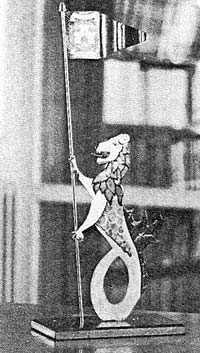
The Trinity crest is borne in heraldic style in the headmaster's study, made by pupils
Was the new Grammar School inferior to the old one? In the first article I recalled the debate which went on over the identity and status of the Northampton boys' grammar establishment, with four centuries of history and tradition behind it, and the Northampton Trinity mixed grammar school, which survived little more than four years under the title of "grammar", a name achieved only after controversy and almost immediately lost with the introduction of the comprehensive system. Today the debate which went on seems, to coin a phrase, almost academic and to have happened more like a century ago than a mere handful of years.
With the start of the new comprehensive system there came to an end that
celebrated agonising period for parents and children as they waited to
see whether 11-year-old Jimmy or Jane had passed the examination which
opened the door to one of the town's three grammar schools.
But at the same time a new worry was introduced for many parents. Now,
in theory at least, they had choice - and the responsibility which goes
with it. My wife and I faced this situation a couple of years ago.
Should our son go to the old ex-grammar school in Billing Road or to the
new ex-grammar school just round the corner in Trinity Avenue? Our
limited knowledge of the Trinity school was clouded by the confusion to
which I referred last month. Whereas, as a semi-old-boy, I had some
personal knowledge of the Grammar School in Billing Road.
"Semi-old-boy"? I must explain that one. From Stimpson Avenue
School at 11 I had gained the much desired scholarship to Billing Road
but my parents left it to me as to whether I accepted it. And being a
bit odd I decided not to. What one of today's educational
psychologists might make of it I do not know but the fact is that, being
a shy violet, I just could not face up to the obligatory summer headgear
of a straw hat.
In those days, happily, there was another alternative - the two
intermediate schools which the town then included in its educational
tiers, half-way houses between the senior schools (which later became
secondary moderns) and the grammars. I opted for Campbell Square
Intermediate School and, under that magnificent headmaster Arthur
Poulton, studied there for three years. I never regretted the choice,
illogical though the reason for it might appear to have been, and could
still make out a case that this type of school was better than either of
the other two.
But at 14, by gaining sufficient passes in the then Oxford Junior examination I gained a second chance scholarship to Billing Road and this time I took it, spending two years there just before war broke out and scuppered my ambition to enter the Civil Service (all exams being cancelled).
I paint in this background to illustrate the problem I faced, in
substitution for 11-plus trauma, regarding my own son. I knew the
400-year-old school and asked myself: would it face more problems in
shedding its ancient traditions than the almost brand new one? I fancied
that it would but my wife and I went along as prospective parents to
both schools.
At Billing Road we listened to the brand new head, Dr. David Abbott,
whose predecessor had left in disgust rather than preside over what he
regarded as the emasculation of his school. At Trinity we listened to
Mr. Derek R. Cummings, equally new as a Northampton head. Back
home we discussed our impressions but just could not make up our minds -
and when I say we, I mean the three of us. Remembering how my own
parents had allowed me personal choice at a mere 11, I wanted my son, at
a much more mature 13, to have his say. But still we could not decide.
As D-Day approached we were in more of a lather than if we had been
awaiting 11-plus results.
This is, of course, the great age of Choice and Consultation so I
decided to try out the system, by asking for a chat with the Trinity
head. It was so late that there was not even the time to be
courteous and ring up for an appointment. I just walked into the
school and the patient Mr. Cummings asked me into his sanctum and talked
about the way he saw his school, though he could not, of course, discuss
the alternative.
But I already had my own personal reservations about my old school in
Billing Road and the unfortunate subsequent two years there have only
served to prove that my misgivings were correct (though at present anew,
new start is being made there in more promising fashion) and, to cut
short this over-long personal introduction, the decision was for
Trinity.
I found Mr. Cummings to be a very firm believer in the comprehensive
principle but not one of those modernists who believe in the floppy idea
that children should do as they like and work as hard as they like.
This I have been able to see at close hand as a member of the
Parent-Teacher body at the school. I am a great believer in these
organisations, considering that if parent power had been more in
evidence throughout the land, some of the more floppy heads would not
have been allowed such free rein in that minority of schools which have
had such grave problems of near-illiteracy and indiscipline. In my
view parents should talk at these meetings about the fundamentals of
school - how the new style Sixth is getting on or why the Spanish marks
are universally low in Class X - rather than (or at least, as well as)
such events as the fete in the grounds or the controlled volume disco in
the school hall - though both these types of functions operate to the
school's advantage at Trinity. Headmasters of the calibre and approach
of Mr. Cummings are quite prepared to discuss the real nuts and bolts if
only parents are bold enough to raise the basic issues.
It has to be admitted, however, that the fete and disco appear to be the most effective means of getting parents to venture into the school. At Trinity the P.T.A. tried something special. Each member of the committee took away a list of other parents and called on them personally at their homes to tell them that consumer advice, including dealing with queries or complaints, was available through the P.T.A.
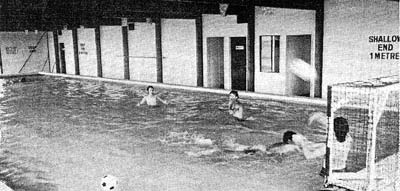
The school swimming pool is shared with other schools
The immediate response was disappointing, as also are the numbers who go along to special evenings to ask questions of a panel of teachers and others or hear careers talks from representatives of local firms and services. The head recently deplored the fact that three per cent had attended one such event. But that does not necessarily mean that the idea of the door stepping exercise is unsound. It's also an education for those making the calls to realise what a wide variety of parents are involved. And in a surprising number of cases to find that the reason for not turning up at evening events is that father or mother is at work at the time.
When the interim period of pre-comprehensive change began at Trinity in
September 1972, with boys and girls entering the school at 13-plus
instead of 11 -plus, there were 500 pupils of whom 40 per cent were in
the Sixth Form. That year work began on extensions to provide the
present Sixth Form block, a swimming pool etc.
With the anticipated birth rate and the intended level of the expansion
of Northampton it was planned that numbers should rise to 1,100 with
intakes of 300 each year in 10 classes of 30. In fact the number of
pupils is stabilising at around 900, because both birth rate and
expansion have levelled off.
Even so the school still has space problems, reflected in the number of
mobile classrooms which have appeared on the tarmac of what we used to
call the playground, but which is known as the "upper quadrangle" -
"Quadrangle sounds a bit posh put playground is too childish for the
pupils of today," commented Mr. Cummings, glancing out of his study
window at the crowds of pupils who had just emerged into the quadrangle
at break time. Among them were many six-footers. The "lower quadrangle",
by the way is the pleasant courtyard of grass between the square of the
main buildings of the school, in which a willow stands, and where an
evening concert was held in July.
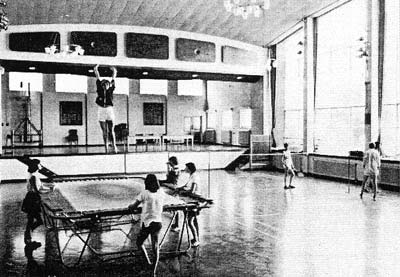
Badminton and Trampoline in the school hall
But in the field of accommodation help is at hand. "We
are taking over what used to be the science block of the adjacent school
which formerly housed the School for Girls" said Mr. Cummings. "After
being converted to our needs it will be used for home economies and
commerce subjects. We had our fingers crossed whether, in view of the
current economy drive, the work would be cut from the estimates but in
fact it is proceeding and we hope to have the block in use early next
year."
The former girls' school has become the new Kingsley Park Middle School and shares the gymnasium with Trinity. Trinity has also shared its swimming pool with a number of other establishments including the former girls' school and some middle and lower schools.
"The new block will release the two rooms at present used for home
economics, which are really part of our science accommodation," he
continued, "and this will allow us to extend our facilities for biology
which has never been adequately catered for, being at present in what
was designed as a workshop. There has been an enormous increase in
interest in biology recently."
Within the confines of a magazine article it is not possible to go into
detail as regards all the many subjects in a curriculum which is very
wide ranging - the larger the school the more subjects can be embraced,
in this field, however, theory and practice do not always equate,
especially when money and space are at a premium. There is also the
problem inherent in the comprehensive system of catering for a wide
range of ability. I remember one parents' evening at which Mr. Cummings
told us about the differences between streaming, banding and setting,
with the aim of getting the pupil in the right group to meet varying
abilities in the various subjects. The new techniques are essential if
the maximum achievement is to be attained by each pupil but it makes the
task of working out the timetable a massive one, and choice of subjects
has to be restricted to a degree.
An Increase in Choices available to pupils |
|
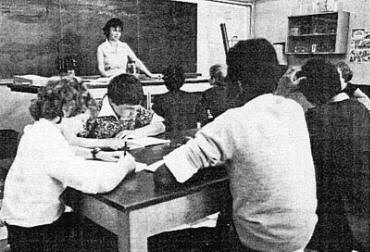 |
 |
|
Biology is an increasingly popular subject |
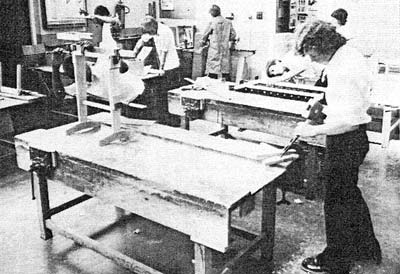
Woodworking classes |
The headmaster told me of two aspects of his school which are not universal:
The first is a scheme under which volunteer members of
the Sixth Form assist with the teaching of less able pupils. "The Sixth
Former gives up one or two hours a week of his non-taught time to help
at the remedial centre in Mobile One, under the direction of a teacher,
or in the classroom, where he can give individual attention to a pupil
who is having difficulty, leaving the teacher free to carry on with the
rest of the class".
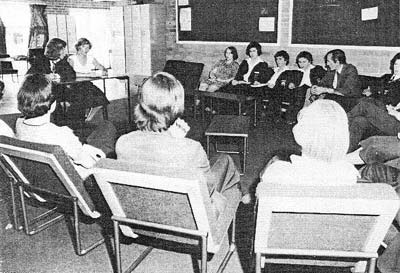
Sixth Form Council Meeting in the Common Room.
At present, for instance, 18-year-old John Corr, an excellent mathematician who has been accepted for the London School of Economics but who is trying for Cambridge, has helped in both situations with boys having maths problems. "And very successful he has been," said the head. "Not only do the younger pupils benefit but the Sixth Formers too. It improves the relationship between the Sixth, who tend to be regarded as privileged, and the rest of school, breaking down barriers."
There, are by the way, no Prefects in the present school. The species
disappeared with the last of the Grammar School leavers. But all members
of the Sixth undertake duties, such as selling dinner tickets and
supervising morning break.
The second scheme is the system of school councils whereby
representatives of each class meet as a committee covering each year,
with their head of year, and discuss their ideas on the way the school
operates. From their deliberations they are able to put up ideas for the
consideration of the headmaster.
With the knowledge that the head is a firm believer in discipline I commented: "A sort of disciplined democracy, or perhaps a democratic discipline ... ?"
"I don't think I would use the word democracy," he replied. "After all
the final responsibility must always be that of the headmaster. If
something goes wrong you can't turn round and say 'But the Third Form
suggested that!' But I do like to hear the children's opinions and
consider their suggestions. By no means every proposal can be accepted
but when it can't at least we can explain why not. Quite a few changes
have, in fact, been made. And more than once my reaction has been
'That's a good idea . . . why didn't we think of it first?".
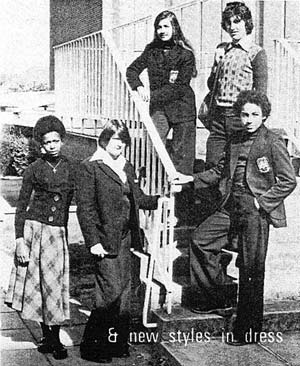
In the Sixth Form new ideas are operating in dress as in other things. Uniform is now optional in the Sixth, and other years have options such as trousers for the girls, roll neck sweaters for boys.
One subject debated by the pupils during the past two years has been the dress to be worn, especially by Sixth Formers. The outcome of this has been that as from the present term girls may for the first time wear trousers and the boys may wear roll-neck sweaters in grey or green (not black as I stated in error last month) instead of collar-and-tie. A small proportion of pupils are now exercising this option - "They look very smart, don't you think?" said Mr. Cummings.
The Sixth now have much wider freedom in clothing. They can either
continue wearing uniform (and many do) or they can wear (great thought
went into the phrasing of this), any clothes suitable for a semi-formal
working situation". This is for a trial period. What is acceptable
within this definition? Well some jeans are 0.K. but not when worn with
a blazer - the two don't match. And shirts with messages emblazoned on
them are out. It is interesting to note that the adjacent new Middle
School has adopted roll-neck sweaters as part of its uniform.
It is also pertinent to recall that when an exchange took place between
Trinity and a United States high school in 1971 several of the Americans
expressed surprise at the English school's formality of dress. Said
Catherine Wayner: "At home we can wear sloppy clothes to class like
sweatshirts, jeans and sneakers - at least people do feel like
individuals." Trinity pupils of the day explained to their guests from
the Rippowan High School, Stanford, Connecticut, that they regarded
uniform as a class equaliser. A couple of years ago Trinity's Sixth
voted against departing from uniform: the new rule came after they
changed their collective minds.
To revert to the question of accommodation, another hoped-for change is
the extension of the library into what is now the music room, which
would be moved elsewhere.
With Mr. Stephen Meakins in charge, music is well catered for at Trinity
and packed audiences (not to mention the youthful cast) will long
remember the production in the school hall earlier this year of "West
Side Story", produced by Mr. Gordon Owen, one of the physical education
masters, and with choreography by Miss Moyra Tebbutt. There is scarcely
another musical which is so well suited to the age range of the school
and yet scarcely one which is so formidable in the complexity of its
tempos and stage movement. The cast of boys, girls and teachers rose
admirably to the occasion, backed with great panache by a guest
orchestra of no fewer than 31 players, levied from among his friends in
the musical fraternity of Northampton by Mr. Meakins, who acted as
musical director.
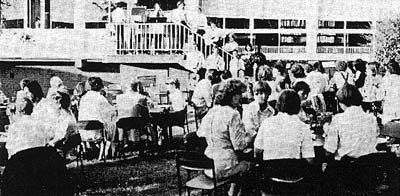
Around the Willow evening. Pupils entertained parents with music and "Call My Bluff"
It is pleasing in a number of cases to find all round artistic ability among the pupils. For instance the two gang leaders, of the "Jets" and "Sharks", who fought so realistically with knives in the show were engaged else where the day I called to complete my story. Howard Hughes and John Brown had an appointment to discuss the 10' X 8' mural they are to provide for the waiting room in the new orthodontics wing at Northampton General Hospital, their joint entry in a competition open to schools in the borough having won first prize.
There are several examples of musical versatility. Simon Roberts, who
sang "Maria" so delightfully in the show, turned up playing the trombone
(from "Scarborough Fair" to "That's a Plenty") at the "Around the
Willow" evening and also sang on that occasion with the Northampton
Music School Choir. Another member of that choir, David Bellham, also
played the double bass in a Bach string quintet and performed a
Beethoven minuet on the piano.
Each summer the English department sponsors an artistic venture. In
South Brent, Devon, two years ago pupils made a film of Thomas Hardy's
"The Withered Arm". Last year a party visited Weston Park, a stately
home in Shropshire, performing a Tudor piece, "Play of the Weather", in
nearby church halls and schools. This year, in an appropriate setting
near Hay-on-Wye, a film was made on an original script concerning an
imagined incident in the Monmouth rebellion, two local primary schools
joining in.
In 1975 a group of Trinity students showed that they can be
business-like as well as artistic when they turned an imaginary
£20,000into £36,800 by Stock Exchange 'dealings' over a period of eight
months - a considerable feat in view of the conditions then obtaining in
the Market. This was in a competition open to schools in the county and
won the school a cup presented by the Junior Chamber of Commerce.
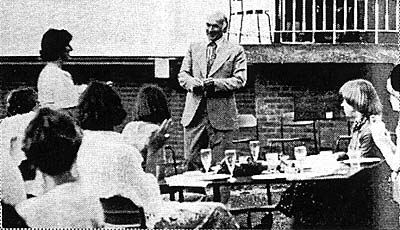
Mr Cummings addresses the recent Around the Willow evening
Born in Oxford Mr. Cummings gained a first class honours degree in languages at the University of Wales and, as an R.A.F. officer, became a modern languages tutor at R.A.F., Cranwell. His previous school posts were at Ecclesfield Grammar School, Henbury School at Bristol, and Kingsbridge School, Devon. He scarcely ever uses the lift in the tower block which is a distinctive feature of the school, preferring the stairs. In some ways a lift is a mixed blessing for a school and he commented: "I know many schools which were designed to have lifts but which have not in fact got them, the lift having been cut out as an economy measure." He and his wife have two children, their home being at Church Brampton. At present he cycles to school, for exercise.
The key question as regards comprehensives is, of course: do they lead
to a failing off in opportunities for and standards achieved by the more
able pupils? With the system in its infancy in Northampton it is too
early to pass any final judgment and lessons are no doubt still being
learned both by the teachers and by the administrators, and will
continue to be learned for some years to come. For instance it may be
that the liaison between middle and upper schools could be improved, to
ensure continuity in education. Without prejudging the issue it must be
a fact that the first wave of pupils now beginning to emerge from the
new system must to some extent have been guinea pigs.
Mr. Cummings considers that some of the criticism of education which has
been made recently is unfair - and said so at this year's prize-giving,
an event into which he has introduced a more informal atmosphere, with
refreshments served by girl cookery students, and greater opportunity
for parents to meet teachers and governors.
How does he regard the opportunities now available at Trinity, in the
fifth year since it began changing its guise? "My concern as a
comprehensive school headmaster must be with every child who crosses our
threshold, whatever his or her ability. As far as the most able children
are concerned we currently offer Fourth Form pupils the opportunity to
take a maximum of nine 0 Levels, or 10 by special arrangement, and our
academic Sixth Formers have a choice of 18 subjects to A Level."
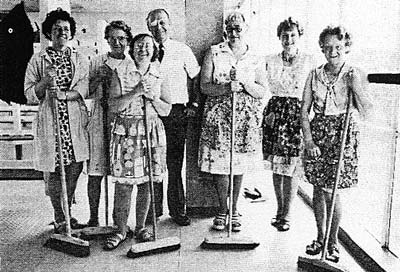
Caretaker Eric Gosling and the school's team of cleaners.
One aspect of the upheaval which has taken place at the school, consequent upon the change of system, has particularly pleased the headmaster - the great stability of the staff. "Almost everything has changed or been modified during the past three years and it has been an exhausting time for all of us," he said. "Yet of the present 24 senior staff 20 were here when I arrived. This is extremely gratifying to me."
A number of the staff are of long service with Trinity, dating back to
the time when, under its then name of the Technical High School, it
shared premises with the College of Technology. Among these are the
deputy headmaster, Mr. L. W. Timms, and the school bursar, Miss M.
Wilkinson.
Another is Mr. H. Hartwell who leads a team of three careers teachers
and who has built up an excellent relationship with local firms, notably
British Timken who some years ago created a precedent by lending one of
their science men to teach at the school, to fill a temporary gap.
Trinity was the first school in Northampton to offer a careers guidance
service and Mr. Hartwell is one of the county's most experienced
teachers in this field.
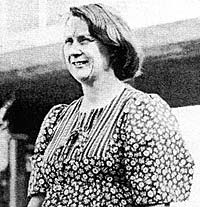
Deputy Headmistress Mrs J H Martin, recently became a Justice of the Peace. [Janet Anderton notes - there was always some conflict with the deputy headmaster, as her official title was still senior mistress].
A third Trinity veteran is Mr. L. G. A. Clarke, who joined the school as a woodwork master, also taking technical drawing and metalwork. Today he is head of the 110-strong Sixth Form.
"Change had to come about in our educational system," he told me, "and in many respects it has been for the better. I find the new era very stimulating and challenging. "Five years ago Mr. Clarke set himself a personal challenge by commencing studies for a degree of the Open University. "This meant a minimum of three hours of work most evenings and of 12 hours at week-ends." But two years ago he gained his B.A. - a fine example of application to the Sixth Formers?
In the school's "Guide to Sixth Form Courses" 'Mr. Cummings writes of
the changed status of this part of the school: "No longer is it the
exclusive territory of an intellectual few heading for a university
degree . . . the doors are open to any boy or girl who can benefit from
an extra year or two years at school in an atmosphere which is very
different from that of the main school. It is NOT necessary to be aiming
for higher education to benefit from time in the Sixth Form: we shall,
of course, continue to send pupils to Universities, Polytechnics and
Colleges of Education, but many others will leave to go straight into
employment with the benefit of extra qualifications and maturity."
Finally Mr. Cummings made a striking comment to me on the manner in
which Trinity staff have met the challenge of new situations. "Perhaps
if British industry had been as adaptable, as prepared to accept
innovation and give new ideas a go, our economy today might be up to
Japanese standards!"