
Peter Douglas writes.
1. Differing Philosophies, or I Confront Gunner!
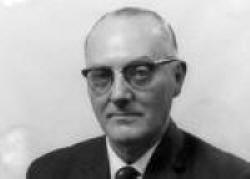 Given
the nature of the man, I should have more memories than I do of “Gunner”
Wright, but only a couple stand out. I saw his face for the first
time in many years when I discovered the Trinity High School website.
There among the images of knobbly-kneed 3rd formers and almost-forgotten
teachers was the stern visage of Gunner Wright, the Deputy Head from
1956 until his retirement in 1968. I later found out that he’d
been teaching at the school (in its various incarnations) since 1933,
but his elevation to Deputy Head Master coincided with my first year at
the school in 1956. There he was again, the high forehead and
mouth set tight. I had not laid eyes on the man since 1963, but
still the steely glare from my computer screen was enough to send an old
familiar shiver down my spine.
Given
the nature of the man, I should have more memories than I do of “Gunner”
Wright, but only a couple stand out. I saw his face for the first
time in many years when I discovered the Trinity High School website.
There among the images of knobbly-kneed 3rd formers and almost-forgotten
teachers was the stern visage of Gunner Wright, the Deputy Head from
1956 until his retirement in 1968. I later found out that he’d
been teaching at the school (in its various incarnations) since 1933,
but his elevation to Deputy Head Master coincided with my first year at
the school in 1956. There he was again, the high forehead and
mouth set tight. I had not laid eyes on the man since 1963, but
still the steely glare from my computer screen was enough to send an old
familiar shiver down my spine.
Ironically, my most vivid memory of Gunner was an incident that I
created for myself, and I am still rather proud of the nerve it took,
given the fact that I deliberately took on Gunner over a school policy.
The outcome was more than I expected.
It was probably 1961 or 1962. At that time it was the custom to
have 6th formers take turns reading the lesson from the Bible in the
daily assembly. The whole school gathered in the Hall for morning
prayers and any announcements that Buzzer chose to make or allow.
The school assembled in strict order, the higher your form the farther
back you were, and it was good to be at the back and far from the
teachers arranged on the stage. There was a hymn and a prayer, and
at the appropriate moment, the lesson reader would walk to the lectern.
The heavy, fat Bible was already open at the right page, left like that,
perhaps, from the previous day’s rehearsal before an empty Hall. I
read the lesson at least once; no big thing really as there were
generally only a few verses (I forget how they were chosen) and the
ordeal was brief. Nevertheless, I felt my knees shaking standing
in front of the whole school, and I resented it.
The embarrassment and discomfort was not, however, my main objection to
this routine. What bothered me was being made to mouth the tenets
of a religion that I did not subscribe too. (I think this was
around my Wordsworth phase, and in studying “The Prelude” with Mr. Crick
I had developed more pantheistic ideas of how the world worked.)
And to be frank, I also objected to being made to do anything that was
irksome to me, and if I thought I could get out of it, I was prepared to
give it a try.
I remember grumbling to another pupil one day about reading the lesson.
I think my turn was approaching again and I was going on about how we
shouldn’t have to read the Bible if we didn’t believe what it said.
“Well why don’t you tell Gunner you don’t want to do it, then?” came the
suggestion - the challenge really. It was not proposed with any
seriousness, for the idea was mad! Tell Gunner! Out of the
question! Why make trouble for yourself? He’d never agree,
and surely some punishment would follow such audacity. Still, why
not at least try? I thought. Never being smart enough to keep my
mouth shut, and ever challenged by mindless authority, I decided to put
forward my case.
Some time later, I don’t remember when, following my nervous tapping,
Gunner admitted me into his office with a sharp command. I stepped
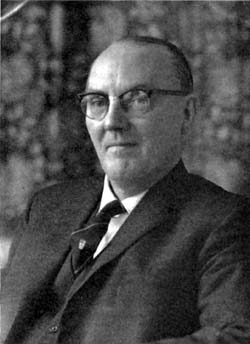
inside and closed the door. He was seated behind his desk, a
position from which he never shifted throughout the interview, his black
gown wrapped around his shoulders, his eyes narrowed behind glasses.
At the sight of him I felt my bravado waver. It was only human to
do so. Gunner had a reputation for sternness and discipline, and
his looks sure fit the part, and so severe and formidable were his looks
that he would not have looked out of place, I remember thinking, in a
group portrait of Third Reich warlords. There was a ludicrous
legend going around that he had once caned someone with a whippy metal
tank aerial; no one really believed that, but at the same time you
thought that if anyone had done, it was surely Gunner Wright. Yet some
said that for all his strictness he could be fair, but whoever said that
was not known to me.
I remember that he steepled his fingers and looked at me from above
them, those grey eyes seeming to penetrate and make my guts roil.
He asked me what I wanted and I just blurted out that I didn’t want to
read the lesson in assembly any more. A short silence ensued in
which his hard stare and my thumping heart was all that I was aware of.
What was in that look, disbelief, rage, curiosity?
 “Really?
And why is that? “He sounded no more than mildly inquisitive.
“Really?
And why is that? “He sounded no more than mildly inquisitive.
Because I don’t believe in what I’m reading,” I told him.
“You don’t believe in God or what the Bible says?” he wanted to know.
“No,” I told him, “not really.” I said that I felt uncomfortable
for being a hypocrite when I read the lesson.
There was another pause, longer this time as he digested my
impertinence, decided on my fate. When he was angry you knew it
from his voice, witnessed many times over the years, roaring down a
corridor to stun some hapless boy into rigidity. This silence was
something new, something sinister. Then his lips twisted into what
seemed a thin smile. It was nothing encouraging. It seemed
the smile of a raptor considering its still-living supper.
Suddenly he shifted in his chair and leaned back, almost casually, and
moved his swivel chair so that he was looking through the window that
looked out on to Trinity Avenue. Green blazers were coming and
going, shouts muffled by glass.
Not turning around he asked, “Do you know Hamlet?” I wasn’t sure
I’d heard him correctly, but I said that I was sort of familiar with the
play, wondering what head games I was about to be made to play.
Turning to face me and raising a finger in emphasis, he quoted, “There
are more things in heaven and earth, Horatio, than are dreamt of in your
philosophy.”
“Yes sir,” I said. Always best to agree.
“All right, I’m releasing you from reading the lesson,” he said,
indicating that I should make that clear to someone, I forget who,
probably some prefect or master. “You may want to change your
mind, and you can if you want.”
“Thank you, sir,” I stammered, shocked and grateful. He made some
gesture that told me we were finished, and I turned to leave. When
I’d reached the door, he stopped me with those same words: “There are
more things in heaven and earth that are dreamed of in your philosophy,
Douglas, remember that.” I said I would, went into the corridor, and
thankfully closed the door behind me.
I was flushed with triumph, of course. I had confronted Gunner in
his own office, and won! That was my story then, and for years
afterwards. I suppose I embellished the tale for my curious
audience, now impressed by my daring, how I defied Gunner and refused to
read the lesson and he gave in. Perhaps that became a minor
legend, who knows? But looking back on it now, I see a timorous
16-year-old pushed into the dangerous spotlight of his own making,
rebelling for the sake of it, challenging on a whim the most formidable
person in his orbit.
I can see now the wisdom that Gunner used in coming to his decision.
In his expected refusal I would have resented his inflexible and
authoritarian attitude. As it was, he relented, and in a novel and
even imaginative literary fashion. And in doing so, he gave me a
challenge of my own - the challenge to think, to wonder about those
other philosophies. It was more of a lesson, really, than standing
up there before the school and reading from that book, and through it I
got my first and only look at that legendary fairness.
 2.
The Haircut, or Gunner Confronts Me!
2.
The Haircut, or Gunner Confronts Me!
This must have happened around 1959 or
1960. I hated games at school and had worked out all sorts of
wangles that my equally non-sporty friends and I could play in order to
get out of loathsome rugby and dodge working up a sweat in PE. In
fact, I produced a limited (very) edition pamphlet entitled “The Art of
Getting Out of Games” that listed (along with attendant hazards) the
several ways I had worked out (many put into practice, some not) of
avoiding exposure to the dreaded Grimshaw.
On the occasion at hand I was experimenting with one of the methods for
avoiding this torture. It consisted of not reporting for games but
getting hold of bunch of papers, a clipboard, or a packet of some kind
and moving purposefully around the school as if on some distinct and
vital mission - delivering something was always good. There were
two obvious defects to this strategy of course, the main one being that
it was all a lie, and exposure would not have been difficult to arrange
had anyone in authority taken the next easy and logical step of
checking. (I suppose we thought the teachers were so dim that we could
fool them so easily, little understanding their years of experience with
the younger generation!)
“I’m supposed to deliver this to Mr. Clements” is the sort of line that
came to mind, but such a pretence would have crumbled in an instant with
the simplest of verifications. The skill was in averting the
check, first by evasion and then by seeming innocent, and also by the
knowledge that few authority figures had bothered to memorise my
timetable and didn’t know therefore that at that very moment I should
have been shivering in the frozen dirt of a rugby pitch or breathlessly
attempting chin-ups in the gym.
The other problem with this ruse was the sheer effort it took, and how
boring it was, to wander (somehow both aimlessly and purposefully)
around the school. Yes, it was tedious and could be exhausting, as
well as a test for the nerves, but that just goes to show how desperate
we were to not play rugger. Better to waste time and risk a
detention than suffer the attentions of the PE masters. Anyhow, we
could always duck into the lavatory to rest in secret (another method).
It was on one of these peregrinations of the school that I thought that
my number was up. It was somewhere in the science block I think,
or the workshops - anyway, somewhere far from conspicuous danger spots -
when I heard the dreaded and unmistakable voice of Gunner Wright behind
me. Of all the rotten luck!
“You, boy!”
There were no other boys around so I knew he meant me. I stopped and
turned around. I was carrying some prop, perhaps a handful of
papers, that seemed to give me a purpose, as opposed to just roaming
around, which was very suspicious. There were lots of rules to
follow - when you could enter the school, when you had to leave, and you
had to walk (not run) inside the school, no more than two abreast, and
no hands in pockets. That sort of thing. It didn’t take much
to attract attention, and Gunner was superhumanly eagle-eyed and was not
to be tangled with at all costs.
“Yessir?”
He beckoned closer me with a hooked finger, all the more ominous for his
silence. His high brow shone and he fixed me in his falcon’s
glare. He looked pleased, and that wasn’t a good sign. It
seemed a sort of suppressed joy at having detected some failure or
impropriety. With Gunner, you could never be sure that he knew who
you were; he gave little away, but you had to assume his terrible
omniscience. I remember vividly the set look of his face that day,
wearing nothing but suspicion, unless it was the pleasure of closing the
trap. He continued to observe me with his pale-eyed and unnerving
stare for longer than seemed natural, long enough to make me decidedly
uncomfortable - his customary, and very successful, tactic.
I mentally rehearsed my deception. Papers for Mr. Clarke, perhaps.
It didn’t matter - I was sunk. Gunner was far too astute to be
taken in by such idiotic subterfuge. Would it be better to come
clean, to confess amnesia, even to claim to be en route to the changing
rooms? Eventually, he spoke. It was mystifying and
conversational.
“How old are you, boy?”
“Fifteen, sir,” I gulped. What was all this? Impossible to
guess. Some evil game, probably. Get me confused with
amiable non-sequiturs and then pounce. Then I hardly believed what
I saw. Was that a smile on his face? Perhaps so, or the closest
equivalent, a crinkling of the thin slit of his mouth, no more,
signalling some cruel satisfaction in his impending punch line.
“Well if you want to live to be sixteen, you’ll get your hair cut,” he
snapped.
“Yessir.”
Without another word he swept on past me, his black gown billowing in
the breeze of his own passage, leaving me to contemplate my luck.
Gunner cultivated strict standards, those of a military college or the
sort of Victorian public school where Tom Brown suffered.
Evidently my longish hair had caught his attention and distracted him
from pursuing the reason for my corridor wandering. It could have
been far worse. It was a relief that that was the only reason he’d
stopped me - not because I was not in the gym where I should have been.
I breathed again.
Not wishing to seem too compliant, three weeks later I did go to the
barber.
Read more about Gunner Wright [Gunner]