
Peter Douglas writes:
Exactly whose idea it was is lost in misty time, but it probably sounded a good idea when it was proposed. It was probably around 1959 or 1960 when someone in the school’s administration (or perhaps Dr. Chater himself) suggested that senior pupils should have the benefit of a class called “Music Appreciation.” I presume that the plan was to raise our level of awareness and comprehension of music by exposing us to it. It was a noble thought, of course, but one that was essentially wasted on our inattentive and degenerate little minds.
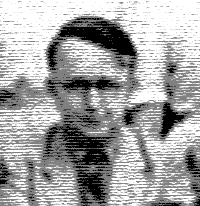
Dr Chater - Crayon Picture
We all gathered as a class once a week in one of the
Tower Block rooms in the late afternoon. The ringmaster of this
particular circus was Dr. Chater, even though his academic interest was
of the scientific kind. It was worth a try, and I’m sure he did a
good job, but it was really a lost cause. The classes were pretty
much as you might expect with 30-odd teenagers made to sit still and
listen to music – and classical music too, no Cliff Richard, Frankie
Avalon, or Bobby Darin!
Dr. Chater explained what we were going to hear, and said something
about the composer before putting the LP on the record-player. We
could have been worse, but proper behaviour was asking a lot.
There was a lot of fidgeting and sniggering, whispering and
note-passing, doodling, and covert attention to homework. But the
very worst was the silly giggling! Someone would make a remark or
a noise, and we’d be off. It spread like an epidemic, made worse
by our efforts to contain it. Eyes watered and noses snorted, and
usually someone let it go and tried to cover it with a cough. For
the most part, Dr. Chater seemed not to care or notice, and usually
gazed out of the window as the music played. I recall he was
driven to call for silence once on the occasion when an ill-suppressed
fart squeaked out and set us off, far worse than usual!
And yet for all this foolishness, one of my most vivid memories of these
sessions, what came to be known as “Music Depreciation,” was quite
moving for me, and I am impressed and a little embarrassed by it.
Since that day, I have heard the music in question a few times, and it
has never failed to evoke that far-off day at school.
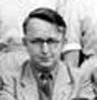
Dr Chater in 1958
It was a winter afternoon, and Dr. Chater’s treat
that day for this gathering of ungrateful clowns and time-wasters was to
be Bedrich Smetana’s “Moldau.” Not that we listened or cared a
damn, but this is a symphonic poem written in 1874 as part of the Czech
composer’s “Ma Vlast” (“My Country”). The Moldau is a river, and
the composition depicts its course as it flows through the countryside,
through forests and by fields, beneath rocks and ruined castles.
Dr. Chater was evidently quite familiar with the piece as he tried to
set the scene for us, outlining what we were about to hear. Two
brooks were represented by the flutes, the surging string melody was the
main river, and there were rapids and water nymphs (giggle), and ending
with the river flowing majestically through the Czech capital.
His brief preamble concluded, Chater set the phonograph spinning and the
crackle of the needle preceded the gentle start of the music. I
wasn’t expecting much; it sounded pretty good music to dream and snooze
by, and it was certainly better than tangling with the Corn Laws,
quadratic equations, or, God forbid, the rigours of the rugby field.
I closed my eyes and let the notes wash over me – well, it was a river,
after all, so the metaphor’s apt. I discovered that I found the
music strangely moving for some reason, and I found the burps and
rumblings of the classroom drifting away. With my eyes closed it
was easy to follow that water’s course, each section of its passage
uniquely evoked by the subtle differences in the music, restful and
quiet by the meadows, accelerated and agitated when we reached the
rapids!
It was very strange! For all the snickering and playing up around
me, I was able to tune it out and really concentrate on the swelling and
collapsing flow of the music. This was something new, a revelation
of how music could affect mood, could allow me some minutes of quiet
contemplation (of what I wasn’t sure) in this loony classroom. I
opened my eyes and, happening to be close to the window that faced west,
I watched the low sun sinking into the cold, red clouds at the horizon.
I was drifting away, transfixed, almost hypnotized, by the music.
The view and the music seemed in harmony, the splendid eternal daily
ritual of nature, the falling sun, the Technicolor clouds smothering it,
this to me imaginary distant river flowing on, the evocative melody
filling my head, the mind of a long-dead composer sneaking into this
banal classroom sixty-something years after his death…
The music ended, as all music must. The Moldau met the Elbe and
vanished into it, and the noises of the classroom returned. They
pushed their ungainly way into my consciousness in the form of the
titters and yawns of my pals, and the stretching and shifting of bored
and restless bodies. We had all just listened to the same piece of
music, but no one else seemed affected by it. Any discussion of
what we’d heard was not an option. Make of it what you will,
seemed to be the line. Everyone rushed out; I just wanted to go
for a long walk and hear the last dying notes of Smetana in my head,
letting the discordant world return if it must, but slowly. Yet I
scrambled out with the rest of them, of course, out into the
rubber-floored corridor and down the noisy, crowded staircase in a blur
of green blazers and jabbering, distracting voices.
But before I left the room I looked quickly back at Dr. Chater. He’d removed the arm from the record and dismissed us with a languid and quite unnecessary wave. He doubtless dismissed us in other ways too, as a pack of unappreciative savages who had been offered a treasure and refused it. I wanted to catch his eye, to let him know that this hour wasn’t wasted entirely, that someone understood… or might understand. Who appreciated. But he wasn’t paying any attention to any of us. He was standing by the window, looking out at that sunset, at my sunset, at that sad diminuendo of the day.