
F. C. Wright, Esq., B.A.
The key article in the 1968 edition of "The Tower" was a tribute to Gunner Wright on the occasion of his retirement in July 1968.
The article is reproduced here.
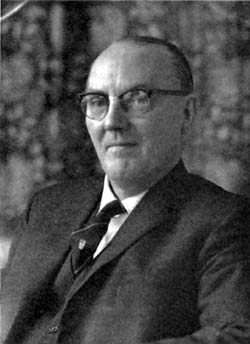 As
most of the school will already know, our Deputy
Head-master, Mr. Frank Wright, will be retiring from
full-time teaching at the end of this Summer Term. Fewer
will realise, however, that he has been on the teaching
staff of the school for 35 years and has been the Deputy
Head since 1956. We on the editorial staff felt, therefore,
that some written tribute should be offered on behalf of the
school, and in this article we have tried to briefly outline
his career, and close association with Trinity High School
in particular.
As
most of the school will already know, our Deputy
Head-master, Mr. Frank Wright, will be retiring from
full-time teaching at the end of this Summer Term. Fewer
will realise, however, that he has been on the teaching
staff of the school for 35 years and has been the Deputy
Head since 1956. We on the editorial staff felt, therefore,
that some written tribute should be offered on behalf of the
school, and in this article we have tried to briefly outline
his career, and close association with Trinity High School
in particular.
Mr. Wright was first trained for teaching at the College of
St. Mark and St. John, Chelsea. He joined the staff here in
1933, the school in those days being the Junior Technical
School. In 1945 the name was changed to Technical High
School and it was situated then in the Technical College
buildings. In 1956, one half of the school moved into the
new buildings in Trinity Avenue under the administration of
Mr. Wright, while the rest remained at the College with the
Headmaster until the present Trinity Avenue building was
completed. Mr. Wright told us that this final move in 1957
has been one of the most far-reaching developments in the
history of the school. Had the move not taken place, it
could never have reached its present size and position.
He recalls too, with pride, the occasion when two boys from
our school first gained University places, and when a former
pupil first obtained a First Class Honours University
Degree. Another of his proudest moments was again a
turning-point in the school's history, when we were first
recognised as one of the Borough's Grammar Schools. It has
always given him great pleasure to hear people of the town
commenting on the good appearance and behaviour of our
pupils; he is equally proud of the status and good name that
the school has been building up for itself over the years.
Perhaps one of the most satisfying developments he has been
a witness to during the past 12 years has been the close
link forged by the school with local industry, the
professions and all public and private bodies which help to
further the interests of the young people educated here; for
instance, the Painton and Timken Exhibitions have been
innovations within Mr. Wright's time. This succession of
incidents which are small in themselves has been a pointer
to the steady growth of the prestige and the academic
strength of this school and the fact that it means so much
to Mr. Wright shows his obvious dedication to education and
his personal identification with Trinity High School.
After 40 years of teaching, Mr. Wright has obviously many
strong views on the principles of education. He is highly
critical of the comprehensive system, largely because that
system demands that comprehensive schools need to be of such
immense size, which makes dealings and communication between
staff and pupils so much harder. Grammar schools are hardly
an anachronism yet; they no longer deal with just the 20% of
boys and girls of the town who were fortunate enough to be
chosen at an early age. Our intake, for instance, of pupils
from secondary modern schools has grown greatly and is
continuing to do so. The opportunities open to these pupils
are the same as those offered to Grammar School, 11+
entrants, once they reach the 6th Form. He claims that the
School as it stands is doing a good job for the society it
serves, and that it is always a pity to do away with
something which is working well, before it is proved that
what will replace it will work better. It is that proof
which he has been seeking but has failed to find.
Mr. Wright is not expecting to enter into complete
retirement, but hopes to carry on with part-time teaching
here for the next two years or so, and then, in his own
words, "to fade out gradually". Although he is looking
forward to his retirement - 40years in the classroom is a
long time - he admits that, without things to think about
and plan for, problems to solve, and a real challenge to be
confronted by, life may seem a little empty at first.
However, there will be no lack of suitable employment for
him. His intensive activity in the garden, including the
care of his treasured 100 rose bushes, will occupy most of
his time. Perhaps in a different way, be will find this as
creatively rewarding as his teaching has been.
For he looks back with few regrets over his long career in
school. He would gladly re-live his experiences from the
beginning. Apart from all else, he tells us, he was glad to
have been chosen to be Deputy Headmaster of a Grammar
School, because it has allowed him to pursue, to a higher
level, his interest in the subjects (French and Latin) that
he teaches. This is surely fulfilment in itself.
We must stress too that his forceful qualities as a natural
leader and organiser have been employed to the full in his
important administrative role as Deputy Head. As pressures
have built up over the years, it has been Mr. Wright's
clear, calculating mind which has served him and us so well.
The force of his personality and the breadth of his
influence have been recognised by all who come into contact
with him. Several generations of past pupils can now look
back, and remember how, as small boys, trembling with
anticipation, they awaited their first confrontation with
the legendary "Gunner", after having committed some
childish, or more serious, misdemeanour. They will, no
doubt, remember too the terrifying roar of his voice when
raised in anger, and the punishment, firm and fair, as it
always has been. They, along with us who are older, can
understand better now than they once did, that here is a man
whose principles were set upon the bed-rock of integrity,
firm discipline (self-discipline, where possible) and an
educational system where vagueness and disorder find no
place. This, for him, has proved to be the foundation upon
which to build throughout his teaching career: to create
order, where no order existed.
We would like, therefore, to extend to him our most sincere
wishes for his happiness, along with that of Mrs. Wright
too, in the many years that lie ahead during his retirement,
and to offer our thanks, on behalf of past and present
generations of scholars, for the intensive work he has put
in and the amazing dedication he has shown to Trinity High
School.
E.M.N. and M.J.S.
John Child has this amusing tale to tell about "Gunner".
In the middle to the late sixties Carole my girlfriend and
myself ran the Junior Sunday School at St. Alban's Church
which also was the church which Gunner attended each week.
In those day Sunday Schools were big - we had about 80 kids
each Sunday morning.
To raise funds we used to organise car treasure hunts which
were great fun. Gunner got to hear that we were
running one and I got a message that he and Mrs Gunner would
like to come. So I went round his house in the
Headlands and he came to the door and invited me in.
Despite the fact that it was 1967 and I had left school 4
years earlier and was well into the world of work commuting
on the train daily to London I was a bag of nerves. I
got his change all muddled up but he was quite kind and put
me right. I don't know whether he recognised me; I
think not. Anyway we decided to make the treasure hunt
particularly tough on this occasion. To get the clues
one had to march around farmyards to find the name of who
built the barn etc and look in the most obscure places.
Those participating also got points for making a daisy
chain, getting hold of a 1950's three-penny piece and
finding a lolly stick if I recall correctly.
The finishing point was in a field and one of the last cars
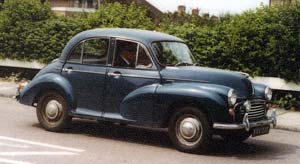
to arrive was no less than Gunner's blue Morris Minor which
came bumping across the field. He pulled up sharply
and handed me his sheet plus his 'additional' items.
He mumbled something about late for Evensong and sped off
into the distance.
 I
pawed over his paper with relish. Here was a chance to
get a pile of red ink on his script. What fun!
The problem was that he and Mrs. Gunner had got every darn
answer correct and had also made the daisy chain and found a
three-penny piece and a lolly stick! They won first
prize - a leather steering wheel cover which I later had to
present to him and which I saw fitted on his car where it
remained for many years. But he never asked about
coming along on future car treasure hunts!
I
pawed over his paper with relish. Here was a chance to
get a pile of red ink on his script. What fun!
The problem was that he and Mrs. Gunner had got every darn
answer correct and had also made the daisy chain and found a
three-penny piece and a lolly stick! They won first
prize - a leather steering wheel cover which I later had to
present to him and which I saw fitted on his car where it
remained for many years. But he never asked about
coming along on future car treasure hunts!
Gunner was born in 1906 and died some 8 or 9 years ago, and was cremated at the Northampton Crematorium. If he were still alive he would be 98. His sister is still alive and she is approaching 90. His niece, Margaret Rudd (Dillon when at school) does not believe that the photos that used to appear here are actually of Gunner's wedding. She says that his wife was quite a bit shorter than Gunner, and in the photos, the bride is almost as tall as the groom, and she also does not think that he got married in a morning suit. She is checking with her mother, so the pictures may come back.